Every line switches on at once.
Paid phone lines on any website, paid by the second, straight to the person you call. Switched on by Bitcoin itself at block 971,000.
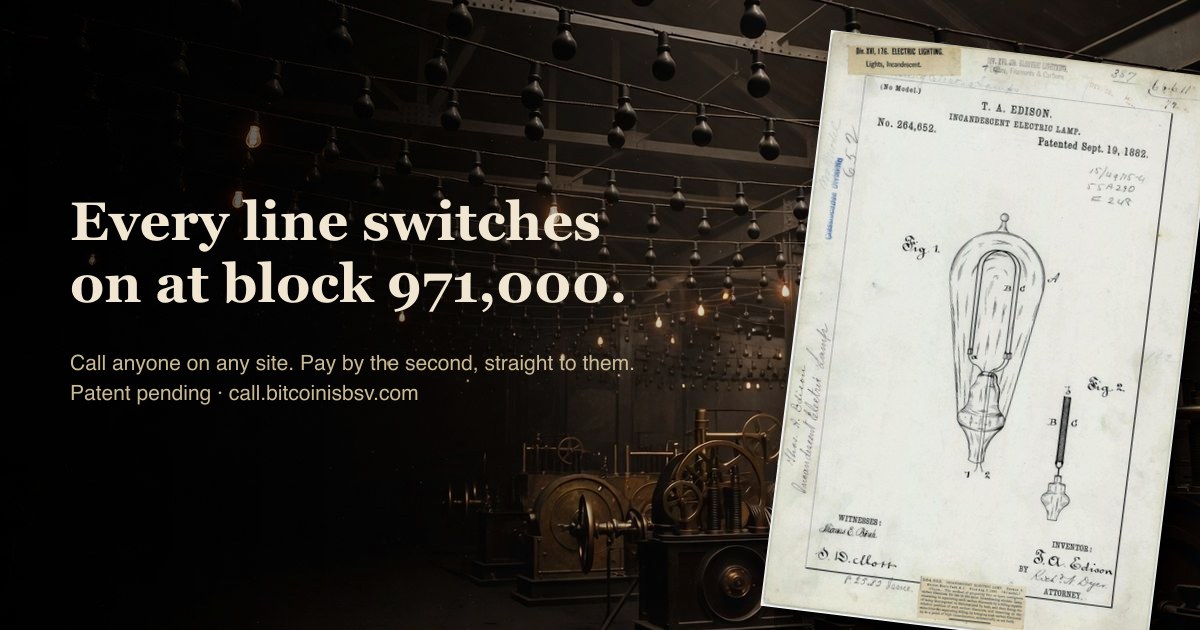
On 4 September 1882, Thomas Edison threw a switch at Pearl Street in lower Manhattan, and the lamps of a square-mile district of New York came on together. Not one lamp in a lab. A street, a district, a network: the moment electric light stopped being an experiment and became something you could plug into.
This is our Pearl Street. At block 971,000 on the Bitcoin SV network, due around 14 October, every Open Line switches on together. No server decides when. No company flips it. The network mines the block, and every line on every participating website, independently, sees it and lights up.
What a line is
A line is a phone number for the internet, with the till built in. Yours looks like an email address: you@yoursite.com. Anyone, on any website that speaks Open Line, can call it. They pay you by the second, at the price you set, and the money goes straight to you. Not to us, not to a platform that pays you out next month. To you, as the call happens.
That is the whole idea, and it has never quite existed. Phone networks let anyone call anyone, but the money flows through carriers. Platforms let you charge for your time, but they hold the money and they own the customer. Open Line keeps the good part of each: anyone can reach anyone, and the money goes directly from the person paying to the person paid.
How the money moves
Under the hood is the payment channel as Satoshi originally described it. When you call someone, your browser locks a small budget in a Bitcoin transaction that only two keys can spend: yours and theirs. Every five seconds you sign a new version of that transaction, paying them a little more. When you hang up, the latest version settles on chain: they get what you used, you get the rest back.
- Nobody holds your money. Not the site you're calling from, not the site you're calling. Neither has a key that can move it.
- Nobody can take more than you signed. Every payment is a signature over an exact amount.
- You are never locked in. If anything goes wrong, a refund to you is already signed before you start.
- The person you call is always paid. Even if you vanish mid-call, their side holds the latest payment and closes it at the right moment on the blockchain's own clock.
It already works. Paid calls have run between separate websites on mainnet since 27 September: from one site to another, settled on chain, with no site ever holding a key.
Your first minute with anyone
Trying something new should be cheap. On lines hosted here, your first minute with anyone pays them 24 sats, whatever their normal price. The Bitcoin network charges its own small fee to open and settle the call, about 75 sats, so a first minute costs around 100 sats in all: still a tiny fraction of a penny. At 45 seconds you're asked whether to keep talking at their rate. Say yes and the call carries on without a break; say nothing and it ends at the minute. Nobody is ever charged more than they agreed.
And if your wallet is empty, your first call can be on the house: new callers get a free first minute to try it.
A line on your website
You don't need our website to have a line. Any website can have one, and that is the point of the demonstration. You add one record to your domain, and your site gets a paid line beside it. Your website stays exactly as it is. With one optional redirect, your line becomes you@yoursite.com.
Every line claimed before block 971,000 appears on the switchboard as a dark bulb, waiting. When the block is mined, they all light.
People first. Then machines.
A call is just the first thing you can meter. The same rails carry anything that can be measured in units and paid as it's delivered. That is where this goes next.
- AI that's paid only while it delivers. An AI answers a line and is paid per answer, per minute, or per token as the words arrive. Stop paying, it stops generating. Neither side can be cheated by more than one unit.
- Agents buying from agents. Your AI assistant hires another AI for a job, pays per request, and nobody holds the money in between. A chain of agents, each paid by the one before, with the first payer's stream throttling the whole chain.
- Budgets you can hand to software. Give an agent a capped, signed allowance for named services, and ask a human above a limit.
- Receipts tied to what was bought. Each payment carries a fingerprint of the exact output it paid for, so every step of an AI's work can be audited.
- Machines paying machines. An EV charger that supplies power only while payment keeps pace, a meter paid by the kilowatt-hour, a device with no screen paid through your phone.
None of that needs a new network or a new token. It needs what switches on at block 971,000: a way for anyone, or anything, to pay anyone else by the unit, directly, with nobody holding the money.
Patent pending. Open Line runs on Bitcoin SV. Hosted lines carry a 5% hosting fee; everything else goes to the person you call.
Edison didn't sell light bulbs to people who had no electricity. He built the station, wired the street, and threw the switch. This is the station, and this is the street. Bring your website, claim your line, and be on the wall when it lights.